96.12% RTP, 10 paylines, and a fisherman who only works when it counts
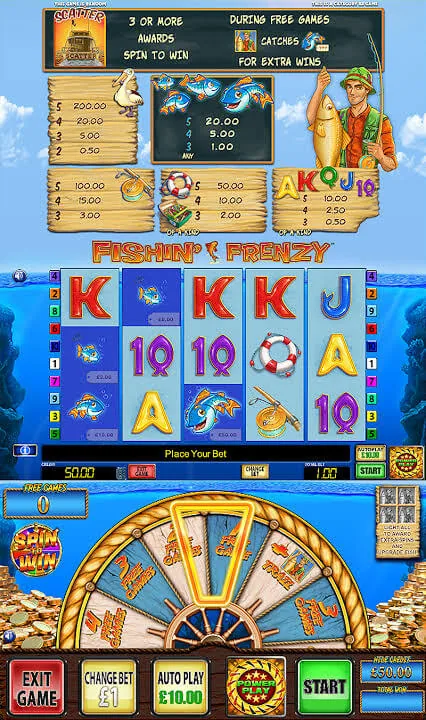
Blueprint Gaming's Fishin Frenzy runs on 10 fixed paylines across a 5×3 grid, returns 96.12% to players over the long haul, and caps the top win at 5,000 times your stake. That last number — five thousand — is the anchor: high enough to feel meaningful, modest enough that the game doesn't swing wildly between dead spins and jackpot chaos. Medium volatility means you'll see regular small wins punctuated by occasional bigger catches, rather than long droughts followed by explosive payouts.
This guide walks through the first 10 minutes, the first hour, and the first week with the game — what happens on each spin, what the numbers on screen actually control, where UK players can legally load it, and the mistakes that trip up newcomers before they've found their rhythm.
What you're looking at: the grid, the paylines, the price per spin
Fishin Frenzy sits on a 5-reel, 3-row grid with 10 paylines that run left to right. You can't toggle them off; every spin covers all 10 lines. Stake ranges typically start at £0.10 and climb to the UKGC's £5.00 cap per spin — or £2.00 if you're aged 18 to 24, a limit enforced by every licensed operator since the Commission tightened youth-gambling rules.
Symbols include low-value fishing tackle (rods, floats, hooks) and higher-value sea creatures. The fisherman wild substitutes for everything except the scatter, but here's the catch: he only appears during free spins, not in the base game. The boat scatter is your ticket to the bonus round — land three, four or five anywhere on the reels to trigger 10, 15 or 20 free spins respectively.
Each fish symbol in the base game carries a cash value, displayed as a multiple of your total stake. In the base game these values are decoration; they only pay out when the fisherman wild lands during free spins and collects every fish on screen in a single sweep.
The first 10 minutes: base game, dead spins, and waiting for boats
Your first few spins will feel quiet. The base game pays modest line wins — three or more matching symbols left to right — but the real action is locked behind the free-spins trigger. You'll see fish symbols with cash values float past, doing nothing. You'll watch for boat scatters, which land randomly and without pattern because the game runs on a certified random number generator tested under UKGC rules.
Medium volatility means you won't wait 200 spins for a feature, but you might burn through 30 or 40 before three boats line up. In those early minutes, bankroll discipline matters: if you're spinning at £1.00 a go and you've set aside £50.00 for the session, you've got 50 attempts to hit the feature and see the fisherman actually do his job. Chasing losses by jumping to £5.00 spins eats that budget in 10 clicks.
Inside the free spins: how the fisherman collects, and why it matters
Once you land three or more boat scatters, the free-spins round starts and the fisherman wild finally appears on the reels. Every time he lands, he collects the cash value from every fish symbol visible on that spin and adds it to your running total. The fish values range from small multiples — 2× or 5× your stake — up to 50× or higher, depending on the variant and the reel position.
The round plays out automatically; you can't re-trigger more spins from within the feature in the standard version. Ten spins means 10 chances for the fisherman to land and sweep up prizes. Some rounds deliver two or three big collection spins and finish above 100× your stake; others see the fisherman appear once, grab a handful of low-value fish, and close out below 20×. That variance is baked into the maths, and it's why the game holds long-term appeal — the outcome isn't scripted, and every feature feels different.
Where to play legally: UKGC licensing, the register, and what to check
In the United Kingdom, every operator offering Fishin Frenzy for real money must hold a remote gambling licence issued by the UK Gambling Commission. The licence number appears in the site footer, usually alongside a UKGC logo. Before you deposit, cross-check that number against the Commission's public register at gamblingcommission.gov.uk — it takes 30 seconds and confirms the operator is legally authorised to serve British players.
Licensed sites display Fishin Frenzy in their slot library under Blueprint Gaming's name. You'll find it at established operators — examples include names like Betfair Casino, Sky Vegas, and Grosvenor — but dozens of smaller UKGC-licensed brands carry it too. These are examples, not endorsements; do your own licence check and read the terms before you commit cash.
Unlicensed offshore sites occasionally list the game, but playing there puts you outside the law and beyond the Commission's consumer protections. You forfeit access to GAMSTOP self-exclusion, the Independent Betting Adjudication Service for disputes, and the statutory codes that cap stakes and enforce affordability checks.
Demo mode vs real-money play: what changes, what stays the same
Most UKGC-licensed operators offer a demo version of Fishin Frenzy, playable with virtual credits after you've logged in and passed age verification. The reels, RTP, feature frequency, and paytable are identical to the real-money game — Blueprint Gaming and the UKGC both require that demo and live versions run the same certified maths model.
What changes: you can't withdraw demo winnings, the session resets when you close the tab, and there's no adrenaline attached to a losing streak because nothing is at stake. Demo mode is useful for learning the rhythm — how often the feature hits, what a typical free-spins round pays, whether you enjoy the pace — but it won't teach you how to manage tilt when you're six buy-ins deep and the boats won't land.
Some players report that demo mode «feels» more generous than real play. This is cognitive bias, not rigging: you remember the demo sessions that went well and forget the flat ones because nothing was on the line. The RNG doesn't know whether you're playing for free or for £2.00 a spin.
First-hour mistakes: stake creep, chasing features, ignoring the clock
- Doubling your stake after a dry spell. Medium volatility guarantees variance; raising your bet doesn't summon the scatter trigger, it just drains your budget faster. Stick to a stake you can sustain for 100+ spins.
- Counting spins until the feature «must» hit. The RNG has no memory and no quota. Spin 47 has the same statistical chance of landing three boats as spin 1; past results don't influence future outcomes.
- Playing through deposit-match bonuses without reading the terms. Welcome offers sound appealing — «100% up to £100» — but they carry wagering requirements, often 35× to 50× the bonus amount. That £100 bonus means you'll need to spin through £3,500 to £5,000 before you can withdraw a penny. Many players finish the playthrough at a loss, even after a good start.
- Ignoring session length. UKGC sites are required to show time and loss counters, and some impose mandatory breaks after extended play. If you're too deep in the session to notice you've been spinning for 90 minutes, you've lost the plot.
Set a budget in pounds sterling before you open the game, not in «number of spins» or «until I hit a big win». When the budget is gone, close the tab. This isn't a strategy to beat the house — the maths guarantee the house takes a long-term edge — it's a strategy to avoid the reckless chase that turns a controlled session into a regrettable one.
The first week: patterns you'll notice, and why they're not patterns
After a handful of sessions, you'll start to see rhythms: some days the feature triggers twice in 50 spins, other days you'll wait 150. Some free-spins rounds deliver 200× your stake, others barely return 10×. You might convince yourself the game runs hot at certain times or cold after a big win. None of this is real. The RNG is a black box that produces statistically random outcomes; it doesn't cycle through phases, and it doesn't punish winners.
What you're experiencing is variance clustering — short-term deviation from the mean that feels like a pattern because human brains are wired to find order in noise. Over a week you might play 2,000 spins; over the game's lifetime, Blueprint's servers process billions. Your sample size is a rounding error, and drawing conclusions from it is like judging a city's weather from three days in June.
By the end of the first week, you'll also have a clearer sense of whether Fishin Frenzy suits your temperament. If you find medium volatility too slow, you'll drift toward high-variance games with bigger swings. If the simplicity feels stale, you'll hunt for slots with layered features and progressive mechanics. That self-knowledge is more valuable than any win you'll land in those first seven days.
Payments, checks, and the practicalities of cashing out
Deposits on UKGC sites accept debit cards (Visa and Mastercard), PayPal, Apple Pay, Open Banking via Trustly, and paysafecard vouchers. Credit cards have been banned for gambling since April 2020, and every payment method must be registered in your own name — no borrowing a partner's card or account. The Commission's affordability rules kick in from £150.00 net deposits per month, starting with soft checks via credit-reference agencies; heavier depositors face requests for payslips, bank statements, or savings documentation.
Withdrawals go out via e-wallets (PayPal, Skrill) in a few hours to 24 hours, Faster Payments to your bank in the same day to two working days, or back to your debit card in one to three working days. Your first withdrawal takes longest — expect 24 to 48 hours while the operator verifies your identity and address using documents you upload. Subsequent cashouts process faster, provided you're using the same payment method and haven't hit a threshold that triggers another check.
Gambling winnings are tax-free for players in the UK; the operator pays Remote Gaming Duty, recently raised to 40% of gross gaming revenue in April 2026. That tax burden doesn't affect your payout — if you win £500.00, you receive £500.00 — but it's worth knowing the operator's margin is squeezed, which is why wagering requirements on bonuses remain high and cashback offers are rare.
FAQ
Can I play Fishin Frenzy on a mobile, or is it desktop only?
Blueprint Gaming built Fishin Frenzy in HTML5, so it runs in any modern mobile browser — Safari on iPhone, Chrome on Android — without needing a separate app. The layout adapts to portrait and landscape orientation, and touch controls replace mouse clicks. Performance is identical to desktop; the RNG and RTP don't change across devices.
What's the lowest stake I can play, and does it change the RTP?
Minimum stakes typically start at £0.10 per spin on UKGC-licensed sites, though some operators set a £0.20 floor. The 96.12% RTP is fixed regardless of stake size — a £0.10 spin and a £5.00 spin run the same maths model. Higher stakes increase the absolute value of wins and losses, but they don't improve your statistical edge or trigger features more often.
How do I self-exclude if I need to step back from the game?
GAMSTOP is the UK's national self-exclusion scheme, free to use and binding across every UKGC-licensed operator. Register at gamstop.co.uk with your name, address, and date of birth; choose a period of six months, one year, or five years; and you'll be blocked from depositing or playing at any licensed casino, including sites hosting Fishin Frenzy. The block is immediate and can't be reversed early. For broader support, BeGambleAware offers confidential helplines and chat services at begambleaware.org.
If I hit a big win, is there a cap on how much I can withdraw at once?
UKGC rules don't impose a universal withdrawal cap, but individual operators set their own limits — commonly £5,000 to £10,000 per transaction or per day, rising to £20,000 or more for VIP-tier accounts. Wins above the cap are paid in instalments over several days or weeks. Check the cashier terms before you play; a £25,000 hit is exciting until you learn it'll be dripped out over a month, and any balance left in your account is temptation to spin it back.